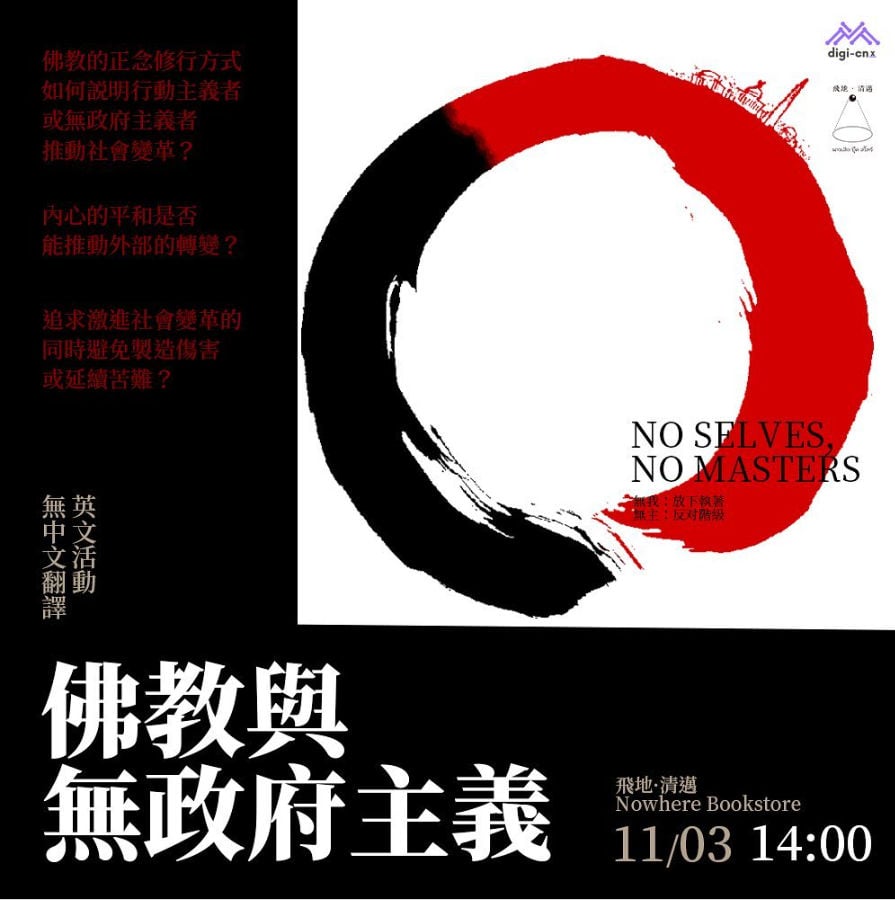

Buddhism and anarchism, though originating in distinct realms—spiritual and political—share key commonalities that make for a thought-provoking intersection. Both reject coercive authority and hierarchical structures, emphasizing individual responsibility and autonomy. Buddhism, particularly Zen, encourages personal liberation through inner peace, mindfulness, and detachment from desire, while anarchism advocates for a free, non-hierarchical society based on mutual aid and voluntary cooperation. Both traditions emphasize non-violence and compassion, valuing simplicity and interconnectedness within communities.
However, notable contradictions exist. Buddhism’s focus on spiritual detachment and acceptance of suffering contrasts with anarchism’s drive for political resistance and material change. While Buddhists aim to alleviate suffering through personal transformation and mindfulness, anarchists see suffering as rooted in unjust social systems that require active resistance. Additionally, the hierarchical nature of some Buddhist communities contrasts with anarchism’s emphasis on egalitarian, horizontal structures. Despite these differences, the overlapping values of personal freedom, non-violence, and community-based ethics make the relationship between Buddhism and anarchism a fascinating area of exploration.
Joah is the host of Insight Myanmar podcast and Yucca is Research Director at Exile Hub.
Questions
questions to think about as one explores the readings/material
In what ways might the mindfulness practices of Buddhism help activists or anarchists in their efforts to create social change? Can inner peace fuel external transformation?
How can the Buddhist principle of compassion be applied to anarchist goals of dismantling oppressive systems? Is it possible to pursue radical social change without creating harm or perpetuating suffering?
Both Buddhism and anarchism value non-violence, but how might the Buddhist approach of acceptance and detachment differ from anarchist's advocacy for direct action and resistance? Is one approach more effective in creating change?
Recommended Reading
https://noselvesnomasters.com/
https://insightmyanmar.org/podcasts
——
We are grateful to our host: 飛地 Nowhere
Nowhere Bookstore is a “third culture” Chinese language space.
|飛地 Bookstore is its physical space where cultural activities including lectures, publishing, curation, theme camps and other cultural programs can be expressed . At present, 飛地 Nowhere has footprints in Taipei, Chiang Mai, the Netherlands, and Washington DC, with more more spaces expected in the future.
The Digital Humanities Un-College (or the Un-College for short) is an initiative by digi-cnx and collaborators to offer curious popup villagers and Chiang Mai residents the chance to join or lead college-style learning activities on topics of their interest, under the broad umbrella of the ‘digital humanities’ (technology, society, history, innovation, the cosmo-local, policy, ethics, and more!). Follow us on Twitter/X for updates or subscribe to our newsletter.
The Un-College is open to anyone to submit and host a session. To learn more about designing a session visit our website
digi-cnx is a local Chiang Mai network committed to dialogue and research on how digital technologies are impacting both people and our planet.