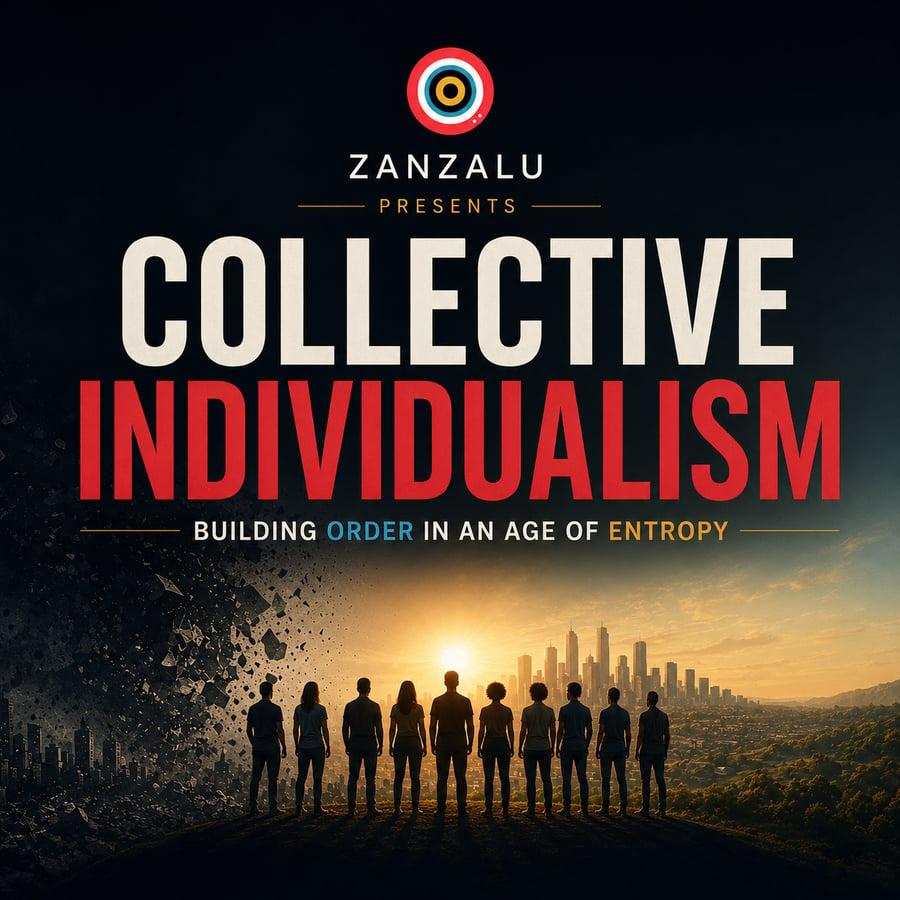

Collective Individualism: Building Order in an Age of Entropy
Why do some civilizations, companies, and communities endure while others collapse? Why do some groups consistently shape the future while others are forced to live with the consequences of decisions made by someone else?
This session explores a simple but powerful idea: the world is not only shaped by individuals, but by organized people acting together around shared purpose.
We often celebrate individual success, yet history shows that the greatest advances in science, business, governance, and culture have come from institutions, networks, and communities that outlived any one person. At the same time, every institution faces a constant force pulling it apart. In physics, this tendency toward disorder is called entropy. In human systems, it appears as conflict, complacency, short-term thinking, and fragmentation.
Creation is the act of resisting that pull.
Collective Individualism argues that lasting progress requires two commitments. First, every individual has a responsibility to become capable, independent, and principled. Second, capable individuals must choose to build and preserve institutions that create value beyond themselves.
This is not a call for blind loyalty or conformity. Strong collectives are built by strong individuals who voluntarily align around shared values, accept disagreement, and remain committed to something larger than their immediate interests. The strength of an organization is measured not by the absence of conflict, but by its ability to remain united despite it.
Together, we’ll explore questions such as:
Why do organized groups consistently have more influence than isolated individuals?
What can entropy teach us about businesses, communities, and civilizations?
How do we build organizations that survive disagreement and outlive their founders?
What does it take to balance personal ambition with collective responsibility?
Whether you’re building a startup, a movement, a research community, or simply thinking about how societies evolve, this session offers a framework for understanding why creation, cooperation, and institution-building remain some of humanity’s most important acts.
Because the future doesn’t belong to the strongest individual.
It belongs to the strongest communities of capable individuals who choose to build, protect, and create together.