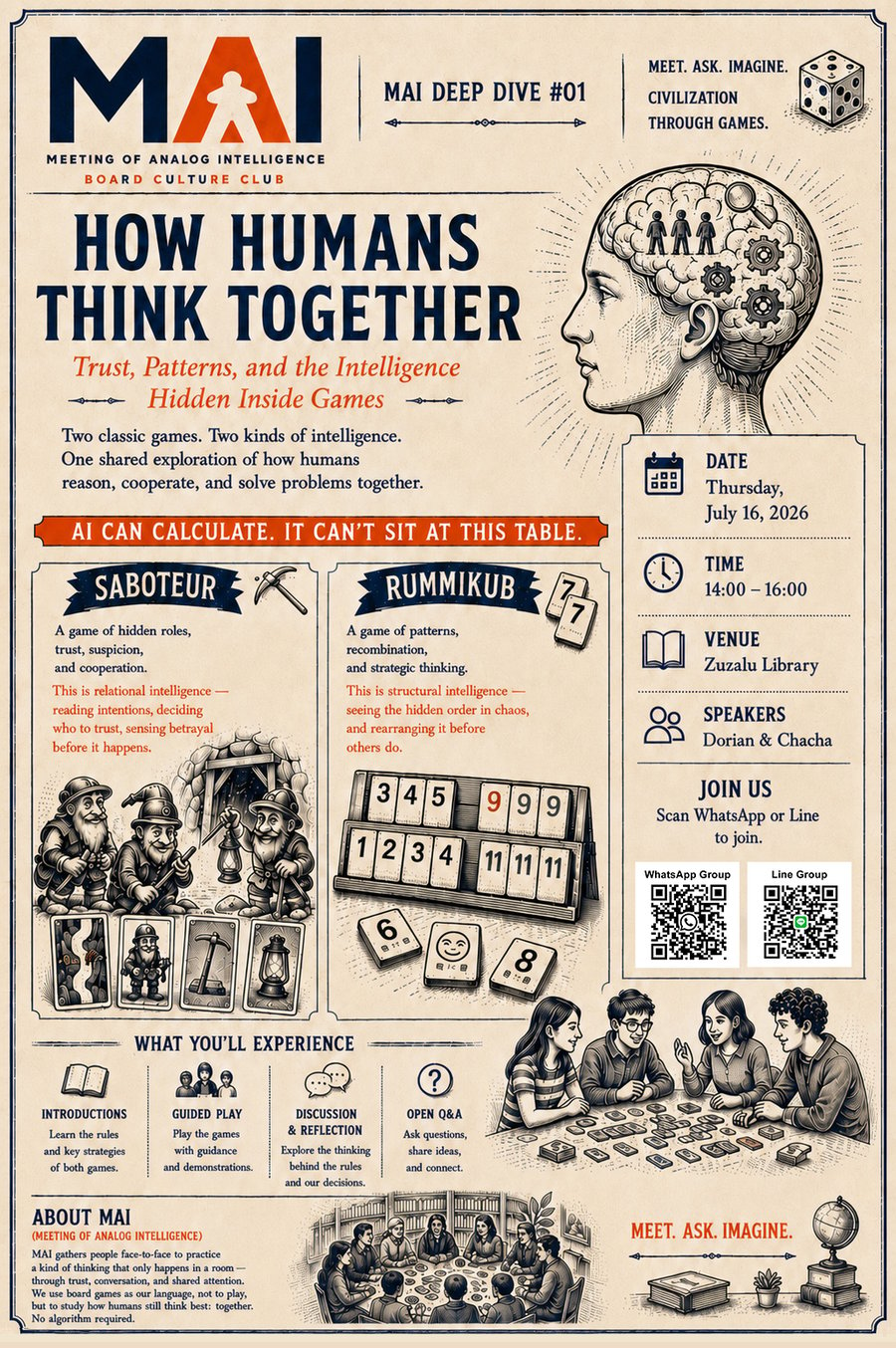
Trust, Patterns, and the Intelligence Hidden Inside Games
Join us for the first MAI Deep Dive, a guided board game workshop where we use classic games as a way to explore how humans think, cooperate, and make decisions together.
MAI Deep Dive is a curated session by MAI — Meeting of Analog Intelligence.
Unlike a casual game night, each Deep Dive focuses on a question, a theme, or a public issue. We play games not only for fun, but also as tools for observation, conversation, and shared thinking.
For our first session, we will explore two classic games: Saboteur and Rummikub.
Two games.
Two kinds of intelligence.
One shared table.
AI can calculate. It can’t sit at this table.
What We’ll Explore
Saboteur
A game of hidden roles, trust, suspicion, and cooperation.
In Saboteur, players work together — but not everyone has the same goal. Through this game, we will explore relational intelligence: how people read intentions, decide whom to trust, sense betrayal, and cooperate under uncertainty.
Rummikub
A game of patterns, recombination, and strategic thinking.
In Rummikub, players build and rearrange number patterns to create new possibilities. Through this game, we will explore structural intelligence: how people recognize hidden order, reorganize chaos, and solve problems through flexible thinking.
What You’ll Experience
This workshop is beginner-friendly. No previous experience with the games is required.
You will:
Learn the rules and key strategies of both games
Play with guidance and demonstrations
Explore the thinking behind the rules and decisions
Join a group discussion and open Q&A
Meet new people through shared attention and conversation
Event Details
Date: Thursday, July 16, 2026
Time: 14:00 – 16:00
Venue: Zuzalu Library
Speakers: Dorian & Chacha
Join Us
To join the event and receive updates, please join one of our groups:
You can also scan the QR codes on the poster.
About MAI
MAI — Meeting of Analog Intelligence
MAI gathers people face-to-face to practice a kind of thinking that only happens in a room — through trust, conversation, and shared attention.
We use board games as our language, not only to play, but to study how humans still think best: together.
No algorithm required.